

2026-09-15
steam playtest delay + summer holiday
Just a quick update: I took some time off! If I could work on this project literally all the time, I probably would, but it turns out that I get much more done if I take breaks and if I'm well-rested—who would've thought? I do not take this decision lightly, but as I am in the service of our overlord "Productivity," I must take actions that exclusively lead to the maximization of production. If it sounds dystopian, it's because it is.
Pill Pusher Deluxe 0.0.4 is sadly still not available on Steam. There are delays on Valve's side, and I don't quite understand why, but I did say "next week" a month ago, and that was only really possible if everything had gotten approved from the get-go, which was always unlikely, so I am definitely to blame here. Despite my time estimates sometimes being wildly optimistic, I always eventually do what I said I would, but I assume my credibility takes a dent regardless, so I do need to work on that. I often think that nobody cares, and I'm sure it's often true; this project doesn't really have an established following, but if there was even one person who was really looking forward to playing 0.0.4 via Steam, I have probably gravely disappointed them—and that sucks! That's not how I want to do things. I need to be even more careful making promises in the future, but this is all valuable experience. The bigger milestones are more important and I am really proud that I have managed to hit this August deadline—this version was a long time coming!
Sometime after my holiday, I will go back to project planning. We're going to have some announcements and possibly some kind of roadmap. The new dev cycle is starting—it feels like a new school year. I have a lot of things planned, but I still don't want to think about the project too much right now. Distance makes the heart grow fonder, after all. Years of work on Pill Pusher are still ahead of me—I must cherish the love I have for the project. Without it, I have nothing. Without it, working on the project full-time would be one miserable dream come true.
-v
2026-08-19
0.0.4 RELEASED
Dear dealers,
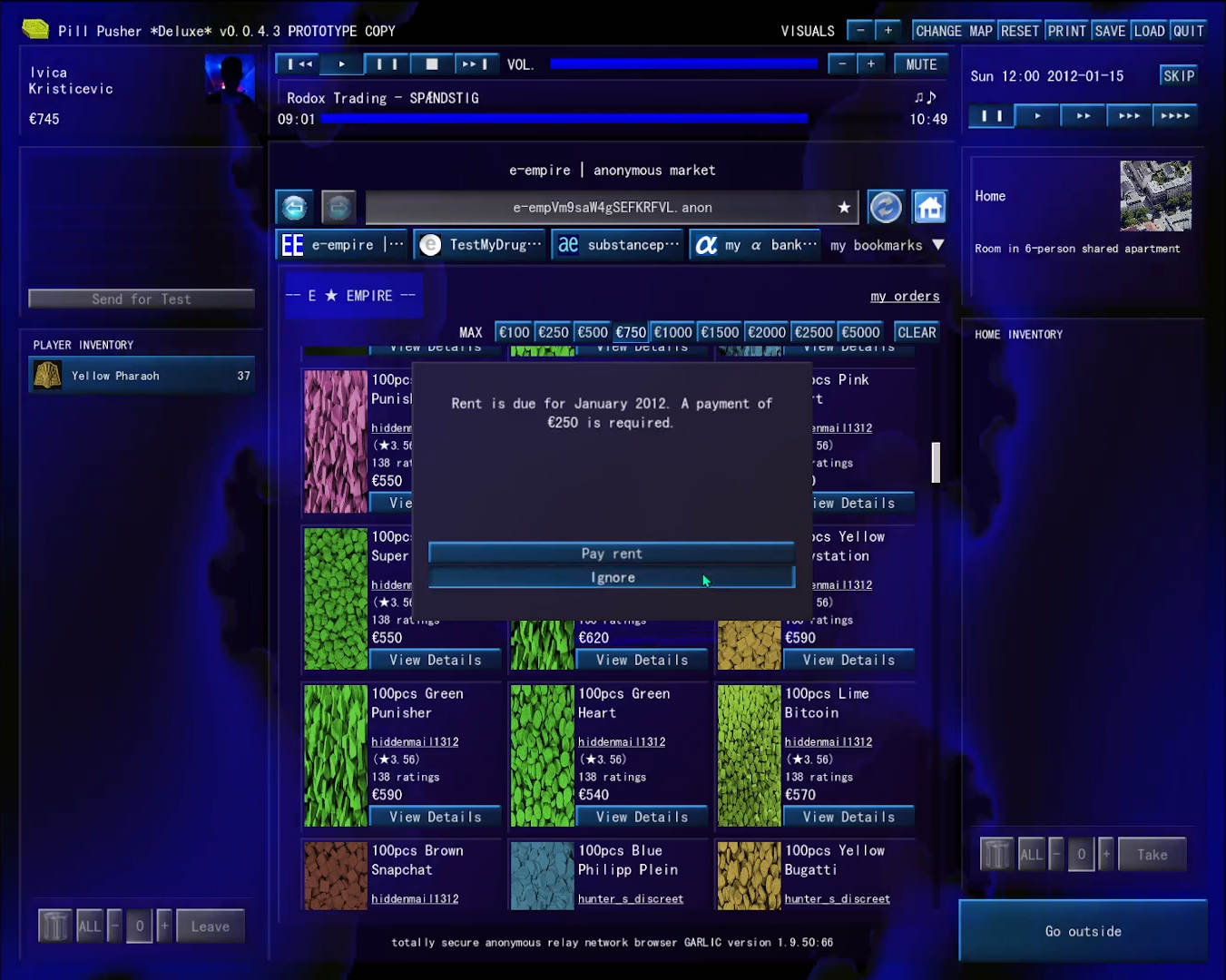
I am super excited to announce that 0.0.4.3 is finally released! For all of you who haven't been able to try it at one of our pop-ups, you can download it right here on the "download" section of the homepage, compeletely for free.
I've been working very hard on this since the beginning of the year and there's a huge difference to 0.0.1!
The new features are:
and more!
As a part of this little release campaign, I've also released a brand new gameplay video. Next week you will also be able to play Pill Pusher 0.0.4 for free on Steam as part of an opt-in playtest. It will conveniently be added to your library, so if you haven't already, follow Pill Pusher ~Deluxe~ on Steam to get notified for all new updates.
Also to celebrate the release, we'll do a final Pill Pusher Popup for some time. We'll be setting things up in an atelier in Hamburg's Gängeviertel this weekend as part of the Gängeviertelgeburtstag event. Be sure to come and say hi if you're in the area.
-v
2026-08-10
0.0.4 release coming next week - biggest update yet!!
Two months of intense development are behind us (or behind me—since it's just me making the game). Traditionally, I'm feeling a tad burnt out, but I can't rest yet—because a new release is upon us!
There have been almost 6 months of full-time work since 0.0.1.1, and the difference is, I hope, quite obvious. We're still missing some core features like crafting and consuming pills, but we're approaching the end of what could be called a prototype and going into alpha territory.
Preliminary testing was successful—just a few little things to adjust before we're ready for release. The bulk of the work remains the teeny-tiny marketing campaign I will run parallel to the release, but this time I will refrain from complaining about having to do that.
By Friday, you will be able to download and play the new version of Pill Pusher ~Deluxe~ from right here, and our first Steam playtest will launch soon after!
I'm excited for things to come. One must imagine Sisyphus happy and all that.
-v
P.S.: I ought to get some feedback for these blog posts... I have no idea what I'm sounding like. Is it really cool and funny and quirky or am I boring and all up my own ass?? I have no idea... Can someone write me an e-mail with some feedback? tnx xoxo
2026-07-01
too shy to post >.< (marketing discourse)
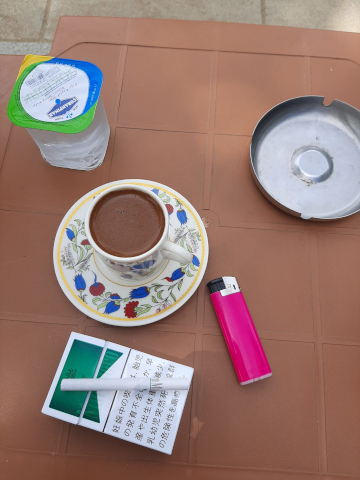
Last week, at a dingy old café, I was having breakfast, a hot cup of coffee and a cigarette — multiple cigarettes, even. With its dying plants and yellow walls, their original color long forgotten beneath decades of tar buildup, it was my favorite place in the neighborhood; it felt like home after all, as it reminded me so vividly of those jolly childhood visits to my grandparents' apartment. I didn't bring my laptop — the space was way too narrow — so instead, I was drawing up something in my notebook. I ordered a second coffee; this time, I needed to do some real work.
The night before, I had a meeting with a friend also stuck in solo dev purgatory. He, like me, always had trouble sharing things he'd created. He was also painfully aware of how much of a handicap that is in this giant battlefield for attention we are all competing in. Despite all my seriousness and commitment to the project, I had not yet drawn up a concrete marketing plan. Except for this very blog, I had not posted any updates anywhere. The time was now — that morning, last week.
I knew that I was going to make a Discord server at some point, but what was really bugging me was social media — the holy grail of reach. I do have an Instagram, but it's private and I seldom use it. To put it lightly, I quite dislike it. In the past, I have tried running multiple social media accounts for my visual novel. The more the better, they said. It turned out to be a bit of a drag, and after some time, I ran out of things to post. It made sense, though; the game was quite small, without many features to rant about. Oh, I just spent a week drawing a new CG scene? Great, but I can't possibly post it because it would be a massive spoiler.
But Pill Pusher is a completely different game. Features are added, new artists are "signed," and events happen. The visual identity is quite developed. If the follower count allows, we could have brand collabs and merch drops. Surely that would make for a good feed? It all sounds great, but I was terribly concerned about the workload creep. It has cost me so much before. Every update requires a short text, a new image, pressing post (in each app through a different UI), and then, worst of all, staying active and replying to people. For a person with notifications turned off for all but one app, this seems like a nightmare.
My philosophy in life is largely avoiding things that don't suit me, and it is how I stay motivated for long stretches of time. Unfortunately, sometimes it can't be helped. As with many other things, I believe that, luckily, it is simply a matter of developing a habit. It's going to be annoying at first, but at some point, I will surely just do it without much thinking. But the workload creep — oh Lord, what about the workload creep?
Some people tell me to "just do it," but I much prefer to believe in the art of careful preparation. Back in that café, after that second cup of coffee, I finally managed to strip everything down to its minimal requirements. With a few bigger updates to the website, a lot of the posts can come as screenshots from there. Add a few templates prepared in advance, and most of the content is covered. With the biggest hurdle cleared, I guess it's time to open the page?
One mustn't forget that things go slow around here. This is someone from the Mediterranean making a game, after all. The website comes first, then the Discord, and then I still have to think about what the visuals will look like, play with them a bit, and only then can I start posting... Meanwhile, I need to start posting on Steam. Someone correctly pointed out the game looked abandoned over there. Developing the marketing infrastructure is just one of the many development tasks in the backlog. Let's not forget, this blog was just the first step to get some updates out there somehow. We're still at the very start. It can be frustrating, but when things start coming together — oh, is it worth it.
-v
2026-06-16
modest setup, lavish success, but what next?
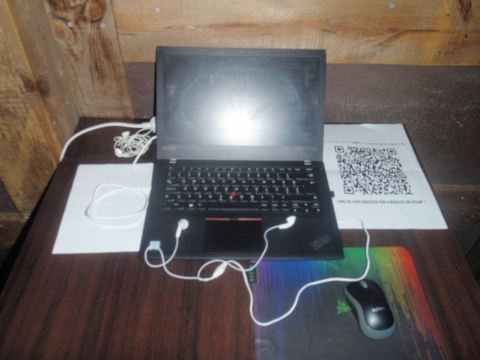
On my cheap old ThinkPad with abysmal headphones and a massive ugly QR code on the side, last month's testing was a resounding success. In 4 hours of a single playthrough the game didn't crash once!! I ran out of stickers and the vibes were good, after all, this game always attracts peculiar people. I didn't check the metrics though - I never do. It's one of the things about my approach that I need to change.
Being just some dude making a game does have its benefits, however. A few weeks ago I sent an email to a certain Danish gentleman that makes some crazy hardcore music and he promptly agreed to let me use some of his tracks in the game, with no strings attached. He even really seemed to like the project! I bet he wouldn't be so kind to a mega-corporation. Everything will be revealed shortly, but this is the first of many expansions of the soundtrack, which ought to be a standout feature.
From today, I'm back on the project full-time. The next testing is in mid-July. I will have the real music visualizer working by then - a perfect way to present the new music. But what else? The truth is, I haven't decided yet. Few things can measure up to the depth and breadth of the to-do list. I will probably prioritize the worst parts - some things haven't changed since the first edition of the prototype. It's all a lot like painting, really. Block out the big parts first and then just keep refining. I'm always fascinated how many skills translate between the arts - often unexpectedly. Maybe after I finish this game I will finally have the skills to make it in the music industry...
-v
2026-05-12
club update and a new round of testing begins!
The event system I was boasting about a couple of months back is paying off, big time. While working on the various bugs, fixes, optimizations and all the other excruciating things that take up most of the development and that the players will never see or appreciate, I have managed to squeeze in some actually noticeable updates to the in-game venues.
Some clubs now have a queue. In others, the bouncers check your bag when you enter. Most clubs require you to pay upon entering (shout out to all those free rave events). Some give you the old stamp, but others don't allow free re-entry (who would do that?). All this will inevitably make the game more difficult, but we're striving for realism here and real life often sucks like that. Crucially, with these little updates it is already possible to design a much more realistic nightlife simulation of your favorite city. Community maps are something that I planned for from the start...
If that sounds exciting, just come to Akihabara next Wednesday and try it out for yourself. With that we are officially launching our next round of testing; all the stuff you read about previously is in the game. Actually, it's not really testing — testing sounds boring and technical — it's an exhibition; May 20th at MOGRA, Akihabara. "But Vaisko, I am in Tokyo, but I planned to get shitfaced in Shibuya, like every Wednesday", you may think, but rest assured, the ¥1500 entry comes with one drink, so it is basically almost like it's forbidden to be sober. No re-entry allowed. See, the mechanic was indeed necessary. Maybe you can even try to sell some pills at the event. Do this at your own risk though.
And if you're accidentally not in Tokyo next week, because you just left for your bi-monthly trip to Thailand (I don't judge), maybe I will do New York or LA next or some shit like that as if I have some kind of cool niche fashion brand or something. Unfortunately, that will probably have to wait a bit because even though someone donated some money to me the other day (shout out to that person), I am still fairly broke so I will stick to Europe when I'm back, at least for this round of playtests. In fact, in July, you will be able to play the game in our lovely Cologne, and by that time I'll probably have time to add some more stuff so see you there?
Well, back to work, there's still a ton I need to fix and days are too short as is.
-v
2026-04-28
roadmap / strategizing / identity crisis
Over the last half a year or so, I have managed to concoct a development strategy that seems like it will fit both my style of work and the project in question. While I like to do as many things as I can "by the book", it is far too daunting of a task for me to scope and budget such a huge game in its entirety. This is, after all, one of those games that can be expanded almost infinitely, in a variety of directions, depending on the interest and wishes of the players.
To be honest, I have no idea what version 1.0 will look like. There are many things I want to add, but spending a huge amount of time deciding if, hypothetically, I would want to add some feature a year or two or four from now into the development when I haven't even had the chance to get any feedback doesn't make any sense at all to me.
Instead, I have decided to develop the game in cycles. Right now I'm working on the alpha version - the second cycle and my next release - set for sometime (late) summer this year. I have a list of features I will add, after which I will test the game at some in-person events and gather some feedback. These events give me a nice, sensible deadline, while the limited timeframe makes it harder to overscope, avoiding this most common of pitfalls. It is, of course, also a valuable opportunity to meet colleagues and players, and, importantly for me, a good excuse to travel. This will all be complemented with a new (slight) marketing push and reaching out to more artists in an effort to add some more tracks to the music roster. After I have tested and fixed up the game, the release will follow and then; another cycle begins. Defining new development goals, a new deadline, marketing push, reaching out to more artists and then, again, in-person testing before a new release. Once I get any semblance of a community, we can get the hype train going for each release. We can get some funding for the next cycle. Much easier to manage, execute and not over-promise. All things considered, a sound plan.
Alas, I am not a project manager; nor do I aspire to become one. I really do want to minimize any administrative work. Although my business cards list "executive producer" as my title, that was mostly a joke and I really see myself as an artist first or, if you will, (in more business-like language) an art director. I'm not incredibly interested in being a CEO or something like that; especially now that I finally have the confidence to say that I am an ARTIST. As a matter of fact, my biggest inspiration are people like Henry Darger, but then again, while working a dead-end job and living like a hermit is definitely one of my options, it would be alright to make a living from my projects. Do what you love and you'll never work a day in your life - that kind of thing. Although I am definitely not 'normal', it would be nice to preserve at least some semblance of normalcy in my life. If I was really meant to go the Darger route, I would've still been living in that squat.
However, this all kind of leaves me in an ideological clash. On the one hand, I want to have enough profit from the game so that I can at least preserve my current lifestyle and possibly offload some of the development work to a freelancer or two so that I can focus on the more artsy and directorial of tasks. This would inevitably involve running a company which would then add a lot more administrative work to the mix - the thing I wish to avoid. On the other hand, if I continue as a solo dev, the development will remain painfully slow and, depending on my life-situation, I will have to take on more unrelated jobs, which would, in turn, slow down the development even further and consequently ramp up the frustration. I wish there was a way that I could register my business as a religious movement. Curiously, this might not even be completely impossible, considering the brand evolution I have in mind, but I'm already revealing too much.
Anyhow, I guess the answer will be decided for me. Right now I have no choice but to proceed as I am doing now. Although I believe that this will change over time, neither the money nor the hype are not here yet. It's always a good time to stop over-thinking, but this might be an exceptionally good one. Back to coding it is.
-v
2026-03-14
huge updates, I swear, swear to god!!
The big refactor of the most important in-game system is almost finished. After months of work, returning players will finally be able to see that the game is almost exactly the same as before. Although it brings me immense satisfaction to see that many pieces of code are not nearly as dreadful as they used to be, me simply proclaiming that "now everything is better" does not really do much to get the hype train going. So why even bother? As long as the game works fine, who cares what's under the hood? Wasn't all of Undertale's dialogue in one large 1000+ values switch-case statement anyway?
Believe it or not, I do actually adhere to that principle. Hacky suboptimal solutions are here to stay.
On the flip side, time and time again it has been proven to me that when I do put in months of seemingly invisible work to future-proof some part of the project, the effort is almost always worth it. Building a PC to present the project with no clear dates in mind? Suddenly I get an opportunity for an in-person playtest and I already have everything set-up. Creating a Steam page but letting it sit unreleased? It's ready to be published before the playtest - no last-minute scramble neccessary and I can focus on polishing the prototype.
Moreover, there were some real issues that needed to be tackled by this refactor. The current version would always freeze after an hour of two of gameplay, meaning I would have to babysit the PC lest a bunch of individuals walk past a frozen game that otherwise might've tickled their fancy. Quite a few missed opportunities there, I reckon.
But the main point is still the future-proofing. As soon as I am completely done, it will be a breeze to add more events to the game, so the alpha will actually have many tangible differences.
Until then, you will have to trust me that everything is so much better now. Swear to God!
-v
2026-03-02
finally a real (rudimentary) music visualizer
Finally, the four second video loop running in the background is history! The two second video below demostrates:
Over the weekend (to take a break from programming) I have programmed a basic setup for an actual music visualizer. Connected to the audio signal is a bouncing Pill Pusher pill symbol and a fractal shader made by some cool person that shared it for free on github.
This setup now not only syncs to actual music that plays in the game, but also allows me to create different presets and control their intensity depending on what is going on. Rising stakes with more and more drugs being moved, a playlist of tracks with rising bpm, a rise of intensity in the visuals; my goal with all of this is to create synaesthesia between audio, visuals and the simulation. I hope to create a novel experience in a genre where games often lack even a soundtrack (think Gear City, Football Manager).
I always think of making games in the sense of making a total work of art. All the parts need to fit and they all need to have a why. That being said, I don't think that this approach is any better than others -- there cannot be a "right" approach -- but this is the only one that works for me and my brain. Regardless, while being aware of the many pitfalls of perfectionism, my main goal is still only to create the best possible game. If I am even partially successful, I am confident that recognition will follow.
-v
2026-02-20
big refactor: legal upgrade
Who doesn't like the police? They're the cool guys fighting the evil bad guys and they would never do something like harass you for no reason or beat the shit out of you at a political protest or because they found some weed on you.
I have been working on a huge update concerning the event system in the game; arguably the most important part of it since it represents the core of the simulation. With this new system, we already have cool stuff like logging, and we'll even be able to add saving and loading the game in the future. A standout feature (most games don't have this – correct me if I'm wrong).
Anyway, since I know most of my audience thinks the police is really cool and awesome, I put in a lot of work making the police and judicial simulation a lot more robust.
Right now, I have heard that some players were experiencing not even encountering the police once. Selling drugs without the risk of losing your freedom, where is the fun in that?
In the prototype, there was only a steep fine issued if you're caught with a bag of pills, but that's not very realistic.
In the updated version, the outcome of your encounter with the police depends on factors such as how many pills you get caught with, whether or not you have a criminal record and all that good stuff. You might get arrested, let go or the officers might even fail to find the contraband entirely (although, I doubt it, police officers are usually very intelligent). Furthermore, all the seized pills get tested, so if you're caught carrying 200 caffeine pills, you *will* eventually get exonerated, but only after spending a month or two in the can, because the proceedings of the courts are painfully slow, just like in real life! But who knows, you just might end up meeting a new future client or two during your vacation at the local jail.
This is precisely where Pill Pusher *Deluxe* differs from other drug dealing -themed games. It is not simply gamifying the fun aspects of drug dealing, it also simulates the excruciating bureaucracy of its consequences.
I am quite excited about the alpha release. With each addition, the amount of possibilities for storytelling grow exponentially. The first playtests will be in May and I am excited to see the reactions, yet the immutable fact of a lot of work having to be done remains.
-v
2026-02-15
introduction
3 years since my conceptualization of this idea and 2 years into the development I have finally arrived at writing the first dev log.
I often choose to work on my projects without sharing much, even with people I know in real life and I never really talk much to people online. In fact, sometimes I go for days without talking to anyone, but I doubt this is strange behaviour for a game developer. Despite that, I am incredibly serious about projects that I commit to; I zealously adhere to working on them, as if a matter of life and death, but this is known only to some people that know me personally and even though I have (attempting to overcome my shyness) met quite a few people in recent years, it is inevitable that most people interested in this project will be strangers from the internet and because I understand that (as a stranger on the internet myself) working in silence does not garner me any favors, I have decided to also commit to writing periodical dev logs to show the progress that I am making.
Documentation is important, especially in a big project such as this — I have written quite a bit of it so far — and these dev logs are just that; documenting the process of creation. Conveniently, I also enjoy writing.
I am excited to see the project grow, but also to look back on these posts as they will be another testament to the rollercoaster ride and the relentless grind that is creative work.
-v
2025-12-29
test
16__/_tyýþy/_y_,/77yy7,77_7y٪8ťþ7,y,þyþyg7tyť
t
yy
þ7
٪%٪_/_/%€y7,ýyýý7,ý7,ýýýýýýý⁸8 8 ùgugugu 8 ùu8 ùuuùùuùùùù8 uu8 8 ý4